The trouble is, many parents and new teachers aren't sure what "science" is supposed to look like for kids who can't read a textbook or measure a beaker. Is it memorizing dinosaur names? Growing a bean plant? Something else entirely?
This guide breaks down the real objectives behind preschool science: the specific skills, developmental milestones, and everyday activities that build a scientific mindset long before a child ever sets foot in a formal lab.
Key Takeaways
- Preschool science rests on two domains: Scientific Inquiry and Reasoning & Problem-Solving
- Expectations shift between the 36-48 month and 48-60 month stages — growth matters more than hitting a fixed checklist
- Everyday materials like water, bugs, and magnets meet these objectives just as well as expensive kits
- Early science skills drive later gains in math, literacy, and critical thinking
What Are the Core Objectives of Preschool Science?
Preschool science centers on process, not content memorization. A four-year-old doesn't need to know photosynthesis. She needs to know how to ask a good question and figure out an answer.
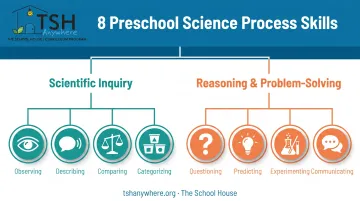
That distinction comes straight from the Head Start Early Learning Outcomes Framework, which organizes preschool science under a domain called Scientific Reasoning, split into two sub-domains:
Scientific Inquiry covers:
- Observing and describing objects, materials, and events
- Using scientific vocabulary in everyday talk
- Comparing and categorizing what they notice
Reasoning & Problem-Solving covers:
- Asking questions and making predictions
- Planning and conducting simple investigations
- Analyzing results and communicating conclusions
Put together, that's eight process skills: observing, describing, comparing, categorizing, questioning, predicting, experimenting, and communicating. None of them require a single fact to be memorized.
Disposition matters too. A child who feels safe asking "why" and comfortable being wrong about a prediction builds curiosity, confidence, and persistence. Those traits matter as much as the skills themselves.
The payoff shows up later, too. A peer-reviewed study on the ScienceStart! preschool curriculum found that classrooms using an inquiry-based approach saw vocabulary gains of roughly half a standard deviation on standardized testing. Inquiry-based science builds literacy rather than competing with it.
Age-Specific Science Milestones: What to Expect at Each Stage
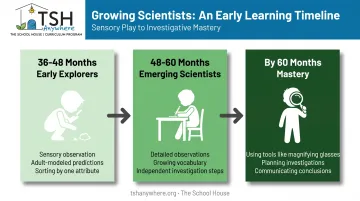
Development isn't a light switch. It's more like a dimmer: gradual, uneven, and different for every kid. Head Start's framework breaks the preschool years into two overlapping stages.
36 to 48 Months: Early Explorers
At this stage, kids lean heavily on their five senses and adult support. Expect:
- Simple verbal (or signed) descriptions of what they notice, like "the ice is cold!"
- Basic questions, usually answered by an adult rather than explored on their own
- Predictions made with modeling, such as "I think the ball will roll faster" after a nudge from a teacher
- Sorting by one obvious attribute, like color
48 to 60 Months: Emerging Scientists
By four to five, children start doing more of the thinking themselves:
- Observations grow more detailed and specific
- Scientific vocabulary expands as kids repeat and ask about new words
- Sorting becomes more sophisticated, using attributes like weight, texture, or sound
- They independently handle small pieces of an investigation, even if an adult still frames the bigger question
By 60 Months: What Mastery Looks Like
Around age five, several indicators tend to converge:
- Extending the senses with tools: magnifying glasses, droppers, or a simple balance scale
- Using real scientific vocabulary: words like predict, measure, and compare show up in regular conversation
- Planning investigation steps: naming what materials or actions are needed before starting
- Communicating conclusions: through pictures, a simple graph, or verbal explanation
These are guidelines, not report cards. A child who's still working on step three at 62 months isn't behind.
Every kid moves at their own pace, and the goal is growth, not comparison to a chart.
Popular Preschool Science Topics That Build These Objectives
Preschool science topics generally fall into three buckets:
- Life science: plants, animals, the five senses, insects
- Physical science: sink or float, magnets, ramps, states of matter
- Earth and space: day and night, weather, rocks and soil
That said, following a specific topic list is optional. Watching a child gravitate toward bugs, the moon, or puddles — and building lessons around that interest — often produces deeper engagement than a rigid curriculum sequence.
NAEYC's guidance on early science learning backs this up. It recommends that adults follow a child's questions and actions rather than steering every activity toward a predetermined outcome.
There's a bonus here, too: these topics don't stay in their lane. Counting seeds ties into math. Describing a caterpillar's texture builds vocabulary. Those connections make science a natural cross-curricular anchor in preschool.
Hands-On Activities That Bring Science Objectives to Life
Objectives on paper are one thing. Getting a room full of four-year-olds to actually practice them is another. Here's how a few classic activities map directly to the skills above:
| Activity | Materials | Objective Practiced |
|---|---|---|
| Sink or float test | Water bin, household objects | Predicting, testing, comparing results to guesses |
| Five-senses nature walk | Nothing but outdoors | Observing, describing, using sensory vocabulary |
| Magnet hunt | Magnets, paper clips, classroom objects | Comparing, categorizing, cause-and-effect thinking |
| Seed planting | Cups, soil, seeds, water | Planning steps, predicting, recording change over time |
None of these require lab equipment. A jar of water, a handful of paper clips, and a walk around the block cover most of the Scientific Reasoning domain on their own.
One step ties it all together: have kids draw or narrate what they found. A crayon sketch of a floating rubber duck, or a preschooler's proud "the magnet stuck to the paper clip!" — that's the communication and reflection piece of the objectives, happening in real time.
How The School House Brings Science Objectives Into Everyday Learning
At The School House, science is woven into the American Emergent Curriculum (AEC) alongside reading, math, and civics. The approach rests on a decade of curriculum research and more than six years of live testing at the flagship School House in East Northport, New York.
That research draws on foundational learning theorists such as Piaget, Montessori, and Gardner. It applies their ideas to how young children actually build understanding: through hands-on exploration rather than worksheets.
For preschool-age learners, that shows up in a few concrete ways:
- Montessori-certified educators (AMI/NAMC) with 14-20+ years of classroom experience guide open-ended exploration instead of scripted lessons
- The curriculum stays deliberately screen-minimal, prioritizing hands-on materials over passive screen time
- The Primary: Science sample centers on "exploration of the natural world through observation and discovery," aligned with Head Start inquiry skills
- An affordable, replicable model gives homeschooling families and microschool partners access to the same research-informed objectives
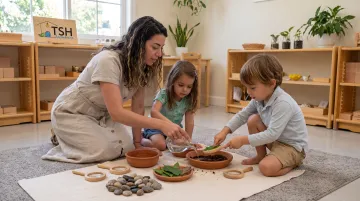
Kids still learn to observe, question, and test the world around them. The curriculum simply builds those habits into everyday classroom life instead of isolating them in a weekly science block.
Frequently Asked Questions
What do preschoolers learn about science?
Preschoolers mainly learn process skills: observing, questioning, predicting, and describing the world around them, rather than memorizing specific facts or content.
What are some good science topics for preschoolers?
High-interest, simple topics work best: the five senses, plants and animals, sink or float experiments, magnets, and everyday weather observation.
What are some examples of science activities for preschoolers?
Try a sink-or-float test with household objects, planting seeds in a cup, a magnet hunt around the house or classroom, or a five-senses nature walk outside.
What is the main objective of preschool science education?
The primary goal is nurturing curiosity and teaching children how to investigate: asking questions, testing ideas, and describing what they find.
How can I tell if my child is meeting age-appropriate science milestones?
Look for developmental indicators like asking more complex questions, making predictions with growing independence, and describing observations with increasing detail and vocabulary.
Do preschoolers need a formal science curriculum?
Not necessarily. A structured curriculum helps ensure consistency and standards alignment, but informal, interest-led exploration at home can meet the same core objectives just as effectively.