That gap is common, and it's exactly why logic gets skipped or pushed to "someday" in so many homeschools. Yet logic quietly shapes how kids read, write, argue, and solve math problems. Ignore it for too long, and you leave a reasoning skill undeveloped that touches nearly every other subject.
This guide covers why logic deserves a spot in your homeschool plan, when to introduce it, the different curriculum formats on the market, and specific picks organized by age and learning style.
Key Takeaways
- Logic is a meta-skill that strengthens math, reading, and writing—not a stand-alone subject
- Pre-logic games and conversation matter most before ages 11–13; formal syllogistic logic fits early adolescence
- Standouts: The Fallacy Detective (informal) and Memoria Press Traditional Logic I & II (formal high school credit)
- A completed logic sequence usually counts as a half- to full-credit elective on the transcript
- Group settings like co-ops accelerate reasoning growth faster than solo workbook study
Why Logic Belongs in Your Homeschool Curriculum
Logic isn't a subject you check off and move past. It's the underlying skill that makes other subjects click. A kid who can spot a hidden assumption in an argument applies that same instinct to a geometry proof, a lab report, or a persuasive essay.
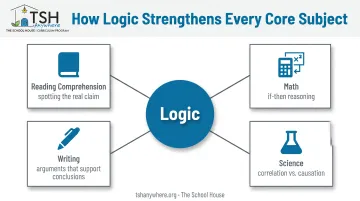
Here's where logic instruction pays off across the curriculum:
- Reading comprehension: identifying an author's actual claim versus their stated one
- Math: following if-then reasoning through multi-step proofs
- Writing: structuring an argument so each point actually supports the conclusion
- Science: distinguishing correlation from causation in data
What the Research Actually Shows
Be skeptical of claims that logic instruction directly boosts SAT or ACT scores. A 2015 controlled classroom study found students who received critical-thinking instruction scored no differently on ACT Science than a comparison group.
A broader meta-analysis pooling 341 critical-thinking effects found a modest overall effect size (g = 0.30): real, but far from the dramatic score jumps sometimes advertised.
The honest takeaway: logic builds general reasoning capacity. It's not a guaranteed test-score hack.
Beyond the Transcript
The everyday value is easier to see. A teenager who's studied fallacies notices when a commercial uses a scare tactic instead of evidence. A kid who's practiced sorting and categorizing at age six handles multi-step word problems more calmly at age ten.
Many classical and Christian homeschoolers treat logic as a bridge subject, the step between grammar-stage learning and rhetoric, philosophy, and worldview formation in high school. Even outside that tradition, the confidence payoff is real.
Picture a twelve-year-old calmly pointing out, mid-dinner-conversation, that a sibling's argument assumes the very thing it's trying to prove. That's logic doing its job.
When to Start Teaching Logic: A Guide by Age and Stage
Timing matters more than most parents realize. Push formal logic too early, and it becomes rote memorization instead of genuine reasoning.
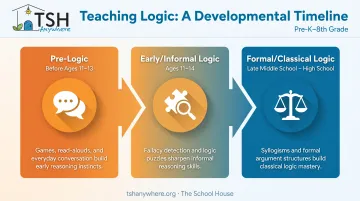
Pre-Logic Years (Before Ages 11–13)
Skip the textbook entirely at this stage. Reasoning develops through play and conversation:
- Games: chess, checkers, Rummikub, and Set all require pattern recognition and sequential thinking
- Read-alouds: pausing to ask "why do you think the character did that?" builds inference skills
- Rich conversation: everyday debates about fairness or rules teach reasoning without a workbook
If you want something structured, workbook series like Building Thinking Skills (Primary/Book 1), Logic Countdown, and Logic Liftoff work well here, but they're optional add-ons, not requirements.
Early/Informal Logic (Ages 11-14)
Something shifts around age 12 or 13. Kids start pushing back with "why" more persistently, and that curiosity makes this the ideal window for introducing informal reasoning and fallacy detection.
This developmental shift lines up with what researchers call formal operational thinking: the capacity for abstract, hypothetical-deductive reasoning that typically emerges around age 11. Before that window, formal logic tends to frustrate more than it teaches.
Good transitional resources at this stage: fallacy-detection books and logic puzzle workbooks like Mind Benders, which bridge informal play into more structured thinking without jumping straight to syllogisms.
Formal/Classical Logic (Late Middle School–High School)
Formal logic (syllogisms, categorical statements, hypothetical reasoning) is high-school-level material, comparable in rigor to an intro college course. Most families start this around 7th or 8th grade at the earliest, with the bulk of formal sequences designed for grades 8 through 10.
On transcripts, this usually shows up as a semester or full-year elective. Colleges generally view it favorably as a rigorous elective, though it's rarely a stated requirement.
Types of Homeschool Logic Curriculum to Choose From
There's no single "right" format. Match the format to your teaching bandwidth and your child's learning style:
- Textbook and video-based courses: Sequential programs that teach syllogisms and traditional logic step by step, often with workbooks plus streaming lessons
- Workbooks and puzzle series: Self-checking, low-prep practice (deductive puzzles, matrix logic, analogies) in daily 5–10 minute sessions
- Games and conversation: Board games, card games, and family discussion as real reasoning practice—especially for younger kids not ready for formal study
- Online or live-taught programs: Outside instruction and accountability when you'd rather not teach the material yourself
- Co-op and small-group classes: Social, discussion-based learning that suits debate practice and splits the teaching load across families
Top Homeschool Logic Curriculum Picks by Age and Learning Style
The Fallacy Detective & The Thinking Toolbox
Ages 12+ · Self-teaching books. The Bluedorn titles are the usual first stop for informal logic. Conversational chapters work well before formal syllogisms, with print around $32 each and ebooks closer to $10.
Memoria Press Traditional Logic I & II
Grades 7+ · Textbook + video. The classical standard for formal logic, covering categorical statements and syllogisms in depth. Complete Sets pair the student text and workbook with streaming video, typically $81–$108 per level.
Building Thinking Skills (The Critical Thinking Co.)
Grades K–8 · Reasoning workbooks. Leveled verbal and figural practice that builds pre-logic skills before formal study. Primary and Level 1 editions run about $30–$38 and work well as a short daily warm-up.
Mind Benders, Logic Liftoff, and Orbiting with Logic
Grades 3–7 (Mind Benders: PreK–12+) · Puzzle workbooks. Short daily deductive puzzles with light prep. Mind Benders levels are about $10–$13 each, so you can start small and step up as skills grow.
Classical Conversations' Reasoning Together
Challenge-level · Community hybrid. Moves from analogies and puzzles into fallacies and philosophy in a classical Christian frame. Home study pairs with peer discussion led by a trained facilitator—best fit if you already use a CC community.
FreedomProject Academy's Homeschool Formal Logic
Middle/high school · Online course. Video-guided Formal Logic built on Memoria Press content when you want structure and outside accountability without teaching it yourself. Self-paced homeschool track starts near $350; live instruction runs up to about $775.
How to Teach Logic Successfully at Home
You don't need a philosophy degree to teach this well. Most successful homeschool logic instruction happens because the parent learns alongside the child, working through the same self-teaching materials rather than lecturing from expertise they don't have.
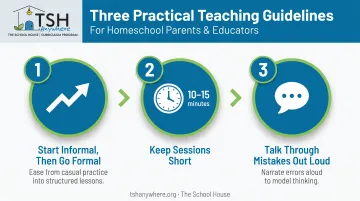
A few practical guidelines:
- Start informal, then go formal. Move from fallacy detection and puzzle work into syllogistic logic. Don't jump straight into Traditional Logic II without the groundwork.
- Keep sessions short. Ten to fifteen minutes of daily puzzle practice beats an hour-long weekly session for retention.
- Talk through mistakes out loud. Wrong answers in a logic workbook are more instructive than right ones when you walk through the reasoning together.
Documenting Credit on a Transcript
A completed formal sequence like Traditional Logic I & II is commonly recorded as 0.5 credit per semester course, or 1.0 credit for the full year.
HSLDA's guidance on determining course credit supports either approach:
- Textbook method: a full-year text = 1.0 credit
- Hours method: 120+ hours = 1.0 credit; 60+ hours = 0.5 credit
Use whichever fits your family's documentation style.
Bringing Logic Curriculum into Co-ops and Community Learning Models
Logic tends to thrive when it's practiced out loud. Debate, Socratic-style discussion, and peer feedback sharpen reasoning faster than a kid working alone through a workbook. Nothing replaces someone pushing back on your argument in real time.
That's part of why more families are pooling resources into small co-ops or community-based school models. Sharing the teaching load for subjects like logic and rhetoric across two or three families makes discussion-based instruction realistic without any single parent carrying the whole load.
Co-op logic sessions work especially well when families:
- Rotate facilitation so no one parent owns every discussion
- Pair short formal lessons with live debate or Socratic seminars
- Give kids peer feedback on real arguments, not only workbook answers
The School House offers a useful reference point for communities that want more structure. Its American Emergent Curriculum builds Critical Thinking & Group Dialogue in as a core, named pillar of instruction alongside project-based learning and structured academic work.
The flagship school model runs Pre-K through 8th grade, so reasoning groundwork continues through the age range (roughly 12–14) where formal logic usually begins. For families seeking a classroom-style option without full private-school tuition, that replicable model—built to stay affordable for working families—offers a middle path between solo homeschooling and traditional private school.
Frequently Asked Questions
What are some good homeschool logic courses?
For informal logic around age 12, start with The Fallacy Detective or The Thinking Toolbox. For formal high school work, Memoria Press Traditional Logic I & II is the classical standard. Building Thinking Skills suits younger students building pre-logic reasoning.
What age should you start teaching logic to homeschoolers?
Pre-logic activities like games, sorting, and rich conversation can start at any age informally. Most formal logic curricula are designed for ages 12–14 and up, once abstract reasoning skills have developed.
Is logic a required homeschool subject?
Logic isn't universally required by state homeschool laws. It's a traditional, highly recommended part of a classical or college-prep education, but families should check their own state's requirements directly.
How many credits is a homeschool logic course worth for a high school transcript?
A full formal logic sequence like Traditional Logic I & II is often counted as one full-year elective, or a half credit per semester, depending on depth and hours logged.
Can you teach logic without buying a formal curriculum?
Yes. Games, read-alouds, and guided conversation build reasoning skills informally at younger ages. A structured resource becomes more helpful once you move into formal syllogistic logic in the teen years.
What is the difference between formal and informal logic?
Informal logic evaluates real-world arguments and identifies fallacies in natural conversation or media claims. Formal logic studies the structure of arguments directly — syllogisms, categorical statements, and rules for determining validity.