The right program blends clear instruction, video support for the topics parents can't fully explain themselves, and enough challenging problems to build lasting confidence rather than just correct answers on a worksheet.
This guide compares the top-rated homeschool Algebra 1 programs on the market and shows how to match one to your student's actual learning style, not just whatever curriculum is trending in a homeschool Facebook group this month.
TL;DR
- Rigorous students: Art of Problem Solving — deepest challenge for competition math and STEM-track learners.
- Average-to-strong students: Foerster's Algebra 1 + Math Without Borders — strong analysis at a manageable pace.
- Independent learners needing support: Mr. D Math — self-paced videos plus live weekly help.
- Struggling or reluctant learners: Teaching Textbooks — maximum independence, with less academic rigor.
- Visual/hands-on learners: Math-U-See and VideoText — manipulatives and short videos for mastery-based learning.
Overview of Algebra Homeschool Curricula
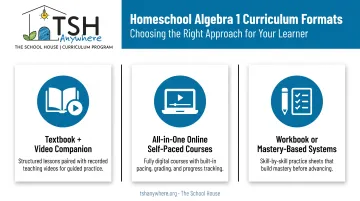
Algebra 1 covers more ground than most parents expect. Homeschool options generally fall into three formats:
- Textbook + video companion: A traditional textbook paired with recorded instruction that walks through each section.
- All-in-one online self-paced courses: Lessons, practice, and grading all happen inside a single platform.
- Workbook or mastery-based systems: Step-by-step worktexts built around visual demonstrations and repeated review.
Homeschooling has grown substantially, which has pushed publishers toward more video-driven, self-grading formats. The federal homeschool rate climbed from 3.3% of children ages 5-17 in 2016 to 5.4% in 2020-21, according to National Center for Education Statistics data.
That jump of roughly 64% means many more families need curricula that don't require a math degree to teach.
The list below ranks the top algebra options based on content rigor, teaching clarity, and how manageable each one actually is for a homeschool household.
Top 5 Best Algebra Homeschool Curriculum Options
Each pick was evaluated on depth of content, quality of explanations, video or instructional support, and how much genuine problem-solving practice it demands.
Foerster's Algebra 1 (with Math Without Borders Home Study Companion)
Paul Foerster's textbook has been a staple in classrooms and homeschools for decades, and pairing it with the Math Without Borders video companion turns it into a complete homeschool course. David Chandler's video lessons walk through worked examples on a whiteboard, replacing classroom instruction section by section.
Why it earns a top spot:
- Analytical depth that goes beyond procedure-following into genuine reasoning
- Word problems that are notably stronger than most competing textbooks
- A video companion that lets a non-math-teacher parent hand off instruction almost entirely
| Format | Best For | Rigor Level |
|---|---|---|
| Textbook + video companion | Average to strong students headed toward STEM | High |
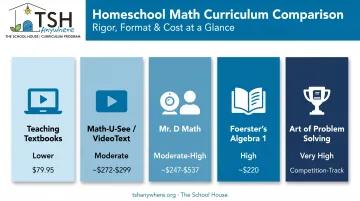
The combined bundle — the textbook plus the digital Home Study Companion — currently runs around $220 total, which is reasonable for a full year of instruction that doesn't require the parent to teach the material directly.
Art of Problem Solving – Introduction to Algebra
AoPS was built for students who want to be challenged, not walked through easy examples. The books introduce problems before explaining the concept, forcing students to attempt reasoning first.
Cathy Duffy Reviews notes that AoPS targets high-performing or gifted students and covers considerably more ground than a typical middle or high school course.
Where it pulls ahead:
- An inquiry-driven structure that builds real conceptual understanding, not memorized steps
- Problems pulled from math competitions like MATHCOUNTS and AMC
- A depth of coverage that often bleeds into Algebra 2 territory
| Format | Best For | Rigor Level |
|---|---|---|
| Textbook, self-taught or online class | Advanced/competition-track students | Very High |
One catch: the books include chapter reviews but no built-in quizzes or tests, so parents wanting formal assessment will need to supplement.
Mr. D Math Algebra 1
Mr. D Math takes a gamified approach, wrapping video lessons, worksheets, and quizzes into either a self-paced or live-instructor format. Students following the self-paced track still get access to weekly Zoom help sessions, a useful safety net when students get stuck.
Built-in advantages:
- Built-in spiral review that revisits earlier concepts rather than isolating each unit
- Live extra-help sessions included at no additional cost, even in the self-paced tier
- A structured 34-week pace chart that keeps families on track without micromanaging
| Format | Best For | Rigor Level |
|---|---|---|
| 100% online, self-paced or live | Independent learners needing built-in support | Moderate-High |
Self-paced access runs about $247 for 15 months; the live class version, with a scheduled instructor and weekly meetings, is closer to $537.
Teaching Textbooks Algebra 1
Teaching Textbooks is the curriculum most families point to when independence is the top priority. Every problem comes with a video solution, hints are built in, and grading happens automatically. A student can genuinely work through most of a lesson without a parent in the room.
The trade-off is real, though:
- It's popular precisely because it demands minimal parent involvement
- Some reviewers and homeschool families raise concerns that its pacing runs lighter than what college-prep or SAT-track students need
- No widely verified study pins down how far behind it runs, so treat rigor concerns as a caution, not a settled fact
| Format | Best For | Rigor Level |
|---|---|---|
| Computer-based, self-grading | Struggling or independent learners not aiming for high rigor | Lower |
At $79.95 for a full year, with 90 flexible pause days, it's also one of the most budget-friendly options on this list.
Math-U-See / VideoText Interactive Algebra
These two programs share a mastery-based philosophy but differ in execution. Math-U-See pairs worktexts with instructional videos and a formula sheet-driven mastery rubric; VideoText uses short videos, most around 5 to 7 minutes, as the primary textbook, with print materials as support.
Shared strengths:
- Constant built-in review woven across lessons instead of siloed into single units
- Strong fit for visual and hands-on learners who need concepts demonstrated, not just described
- VideoText's 176-lesson structure lets students move at a genuinely individualized pace
| Format | Best For | Rigor Level |
|---|---|---|
| Video + manipulatives or workbook | Visual/hands-on learners | Moderate |
Math-U-See's Algebra 1 set runs about $272, while VideoText's online course is priced around $299 — both mid-range compared to the rest of this list.
How We Chose the Best Algebra Curriculum
The most common mistake homeschool parents make is choosing a curriculum for ease or popularity alone, without checking college-prep expectations. That gap often shows up mid–high school, when a student moves into a district textbook for dual enrollment and hits material the home program never covered.
This ranking weighed:
- Depth and rigor against college-prep and SAT-level expectations
- Worked examples and video instruction strong enough for independent learning
- Word problems and challenge sets, not drill-only practice
- Self-grading and independence features, because parent bandwidth varies widely
- Cost compared with private tutoring, which usually costs far more
Rigor mattered, and so did learning-style fit. A visual learner stuck in a dense, text-only program will struggle even if the book is well written, so we favored options that teach clearly in more than one format.
Conclusion
The best algebra curriculum is the one that matches your student's pace, rigor needs, and your available teaching time. A rigorous program wasted on a reluctant learner does more harm than a moderate one used consistently.
Before committing to a full year, pilot a sample chapter or trial lesson. Check whether the explanations stay consistent and whether the practice problems go deep enough to actually test understanding.
If full DIY homeschooling is hard to sustain across every subject, not just algebra, a community-based option may fit better. The School House offers a science-based Pre-K through 8th grade program designed for working families who need an affordable, structured path beyond pure DIY.
Frequently Asked Questions
What is the best algebra curriculum for homeschooling?
There's no single best option. Foerster's Algebra 1 suits average-to-strong students, AoPS suits advanced learners, and Mr. D Math suits families wanting built-in live support.
What is the most rigorous homeschool math curriculum?
Art of Problem Solving is the most academically rigorous option, built for competition math and deep problem-solving skill development.
How do I choose an Algebra 1 curriculum for my homeschooler?
Match the format to your student's learning style, check the rigor against college-prep benchmarks, and test a sample lesson before buying the full course.
Is Teaching Textbooks rigorous enough for Algebra 1?
It's easy to use and great for independent learners, but it often runs lighter than what college-bound, STEM-track students need.
Do I need video instruction for homeschool algebra?
Video instruction helps bridge gaps when a parent can't fully explain a concept themselves, though a strong textbook with detailed worked examples can substitute.
How much does a homeschool algebra curriculum typically cost?
Self-paced and video programs typically cost $80 to $300 for a full year. Live-instructor online classes usually cost $500 or more.