Microschool Curriculum Map: A Proven 8-Step Planning Guide (2026)

You have a clear vision for your microschool. Small groups, hands-on projects, and children who are genuinely engaged. But when it is time to plan what gets taught, when, and in what order, the clarity disappears fast.
That is exactly where a curriculum map makes a difference.
A microschool curriculum map is a planning tool that shows you, at a glance, what your students will learn over the year, how subjects connect, where mastery is expected, and how your time is organized. For educators running mixed-age classrooms with limited resources, a well-built map is what keeps the year from feeling like a series of disconnected days.
This guide walks you through what a microschool curriculum map is, what it needs to include, how to build one step by step, and the most common mistakes to avoid along the way.
Key Takeaways
A microschool curriculum map provides structure for flexible, mastery-based learning throughout the academic year.
Strong curriculum maps align learning objectives, themes, activities, and assessments into one clear system.
Horizontal mapping helps plan a complete year, while vertical mapping ensures skills are built correctly across age groups.
Misalignment between objectives, instruction, and assessment leads to gaps in student progress.
An effective curriculum map reduces weekly planning load and supports consistent, trackable learning.
What Curriculum Mapping Means in a Microschool Setting?
Curriculum mapping is the process of documenting what you plan to teach, when you plan to teach it, and how you will know when students have learned it.
In a traditional school, curriculum maps are handed down by a district or state department. In a microschool, you build yours around your students, your learning philosophy, and your available time. That is both the challenge and the opportunity.
For microschool educators and homeschool parents, a curriculum map serves three main purposes:
Planning clarity: You can see the entire year in one place, so you are not improvising week-to-week.
Skill alignment: You can confirm that core skills are being taught in a logical sequence, with no major gaps or unintended repetition.
Progress tracking: You have a reference point for knowing what has been covered, what was skipped, and where students need more time.
A good map is flexible by design. It gives you structure while leaving room to respond to what your students actually need.
What Goes Into a Microschool Curriculum Map?
A curriculum map is only as useful as what it tracks. These are the seven categories every microschool curriculum map should include. You can organize them in a spreadsheet, a shared document, or a printed planner. The format matters less than the content.
Time Frame: The week, month, or unit cycle you are planning for (e.g., Weeks 1 to 6).
Theme or Topic: The overarching focus of the unit.
Core Subjects Covered: Literacy, math, science, social studies, arts, life skills, etc.
Learning Objectives: What students should be able to do or know by the end.
Key Activities and Projects: The hands-on experiences that deliver the content.
Assessment Method: How you will check for mastery.
Materials Needed: Physical or printed resources required for each unit.
Types of Curriculum Maps

The four established types of curriculum maps come from Dr. Heidi Hayes Jacobs, whose curriculum mapping framework is widely used in US schools and districts. Each type serves a different purpose. As a microschool educator or homeschool parent, knowing which type you are building and when to use each makes your planning more deliberate and more useful.
1. Projected Map
A projected map is built before your school year starts. It lays out your intended plan, covering which themes you will teach, in what order, and across which time blocks. This is the map most microschool educators and homeschool parents build at the start of the year.
A projected map is meant to guide your teaching, not lock you into it. You will adjust it as the year unfolds.
Example: You are a microschool educator starting a new year with a mixed-age group spanning Pre-K to 3rd grade. In August, you map out six thematic units running from September through June: Our Community, Living Things, Forces and Motion, People and Places, Earth and Environment, and Creative Expression. Each unit has learning objectives, activities, and a planned mastery check. That is your projected map. It exists before a single lesson has been taught.
2. Diary Map
A diary map is a record of what actually happened in your classroom. You update it as you teach, noting what was covered, how long it took, and what you adjusted. It is built in real time, not in advance.
A diary map is one of the most underused tools in microschool planning. It shows you the gap between what you planned and what you actually taught. That gap is where most curriculum problems hide, and it is almost impossible to spot without a record.
Example: Three weeks into your Living Things unit, you realize the garden lab took twice as long as expected because students were deeply engaged in observing insect behavior. You record this in your diary map, note that the animal habitat diorama was moved to the next unit, and flag that insect life cycles deserve more planned time next year. Your projected map said six weeks. Your diary map shows what six weeks actually looked like.
3. Consensus Map
A consensus map is built collaboratively by two or more educators who teach the same students or the same subject. It represents agreed-upon expectations for what all students will learn, which assessments will be used, and which non-negotiables apply across the classroom or program.
This type is most relevant to microschools in which two educators share a room, co-teach, or run parallel classrooms under the same program. It ensures students have a consistent experience regardless of which educator leads a session.
Example: Two educators co-run a microschool serving 14 students. One leads literacy and social studies; the other leads math and science. At the start of the year, they built a consensus map together. They agree that all students will complete a community project in Q1, that portfolio reviews will happen at the end of every six-week cycle, and that the same mastery rubric will be used for writing across both educators' sessions. Each educator still has flexibility in how they deliver their subjects. The consensus map holds the shared expectations.
Note: There is a fourth type called an Essential Map, a district-level document that defines non-negotiable learning expectations across an entire school system. For independent microschools and homeschool families, this type is not directly relevant since there is no district overseeing the program. Your projected and consensus maps effectively serve this role at your own program level.
Also Read: Free Curriculum for Homeschool Reading
How Microschool Curriculum Mapping Differs from Traditional Models?
If you have experience in a traditional school setting, it helps to understand what changes when you bring curriculum mapping into a microschool. The differences are significant.
Traditional School Curriculum Mapping | Microschool Curriculum Mapping |
Set by district or state mandate | Built around your students and learning philosophy |
One grade level per classroom | Mixed ages, flexible groupings |
Pacing tied to standardized test calendar | Flexible cycles that respond to student progress |
Subjects taught separately | Themes and projects that connect across subjects |
Content coverage is the primary goal | Mastery is the goal; content is the vehicle |
Built and maintained by the district | Built and maintained by you, the educator |
In a microschool, you are not trying to replicate a district pacing guide. You are building something more responsive and better aligned with how children in your specific classroom actually learn. That requires a different approach to planning.
Steps to Build a Microschool Curriculum Map

Building your curriculum map does not need to be complicated. Work through these steps in order, and you will have a functional, usable map before your year begins.
Step 1: Write Down Your Learning Philosophy
Before any content decisions, clarify what you believe about how children learn. Are you prioritizing project-based learning? Hands-on discovery? Mastery before moving on? Your philosophy shapes every choice that follows.
Write it down in one or two sentences. Keep it visible while you build the rest of your map. This prevents you from making decisions that contradict your own values.
Step 2: Identify Core Subjects and Priority Skills
List the subject areas your microschool will address: literacy, math, science, social studies, arts, and life skills. For each subject, write the three to five most important skills students should develop across the year.
For Pre-K to 6th grade, here is a general guide:
Pre-K to 2nd grade: Phonics, early reading, number sense, oral language, hands-on exploration.
3rd to 4th grade: Reading comprehension, written expression, multiplication, and basic science inquiry.
5th to 6th grade: Critical thinking, written argument, fractions and ratios, research and synthesis.
These skills become your learning objectives. Everything else on your map should connect back to them.
Step 3: Choose Your Time Structure
Decide how you will divide the year. Common options for microschools include:
6-week unit cycles: Allows deep exploration of a theme before rotating. Works well for most mixed-age classrooms.
Monthly themes: Easier to manage, good for younger learners or programs just getting started.
Quarterly blocks: Broader and more flexible, good for multi-subject integration.
Six-week thematic cycles tend to work best in microschool settings. They are long enough for genuine depth and short enough to keep energy and momentum.
Step 4: Assign Themes to Each Time Block
Now place your themes on the calendar, one block at a time. Connect themes to real-world events, seasons, and student interests where you can. A theme like 'Earth and Environment' in spring connects naturally to plant science, weather, and outdoor observation, giving you natural anchors for multiple subjects at once.
Leave a flex week at the end of each unit. Students may need more time on a concept, or an exciting student-led project may emerge that is worth following.
Step 5: Map Activities and Projects to Each Theme
For each thematic block, list two to four hands-on activities or projects that will deliver the core learning. These do not need to be fully planned at this stage. Rough ideas are enough.
The goal is to check whether your activities actually serve your learning objectives. If your theme is 'Our Community' and your literacy objective is narrative writing, a strong project is asking students to interview a family member and write a short story about a memory from their neighborhood. A weak match is having students color a map with no writing component.
Step 6: Add Mastery Checks to Each Unit
Decide how you will assess learning at the end of each unit. In a microschool, this usually looks like:
A portfolio entry showing student work from the unit.
A student presentation or hands-on demonstration.
An educator observation checklist.
A student-led project or community showcase.
For each unit, ask: how will I know this student has understood and can apply what we covered? Write the answer in your map before moving on to the next block.
Step 7: List Materials for Each Unit
Once your themes and activities are mapped, list the materials you will need for each block. This lets you prepare or order resources ahead of time rather than scrambling the night before.
Microschool learning is built around real objects, real projects, and real experiences. Including your materials list on the map makes it practical rather than aspirational.
Step 8: Review the Full Map Before Your Year Starts
Before the year begins, read through your complete map and check for:
Gaps: Important skills that are never addressed.
Overlaps: The same concept is repeated unnecessarily across multiple units.
Pacing problems: Too much content packed into one block, or a block that feels thin.
Then plan to revisit your map every 4 to 6 weeks throughout the year. Curriculum mapping is a living document. Adjusting it mid-year is a sign that you are paying attention, not a sign that something went wrong.
A Sample Microschool Curriculum Map

A full curriculum map includes all seven categories covered in the previous section. The table below is a simplified version showing five core columns: Period, Theme, Core Projects, Skills Addressed, and Assessment. Use it as a starting point and fill in your remaining columns, materials, objectives, and flex notes in your own planning document.
Period | Theme | Core Projects | Skills Addressed | Assessment |
Weeks 1-6 | Our Community | Community Story Writing; Map My Neighborhood | Narrative writing, geography basics, and social studies. | Portfolio entry + oral sharing. |
Weeks 7-12 | Living Things | Garden Lab; Animal Habitat Diorama | Life science, observation, expository writing. | Observation checklist + project. |
Weeks 13-18 | Forces and Motion | Simple Machines Exploration: Ramp Experiments | Physical science, math, measurement, and prediction. | Student demonstration. |
Weeks 19-24 | People and Places | Timeline Project; Reader's Theater | U.S. history basics, reading fluency, and sequencing. | Presentation + reading rubric. |
Weeks 25-30 | Earth and Environment | Outdoor Journaling; Recycling Project | Earth science, persuasive writing, and data collection. | Science journal + reflection. |
Weeks 31-36 | Creative Expression | Art and Story Unit; Community Showcase | Writing craft, visual arts, public speaking. | Community showcase presentation. |
Note: Older students in the same classroom engage more deeply with each theme. A 1st grader and a 3rd grader can both explore 'Living Things,' but the 3rd grader is comparing ecosystems in writing, while the 1st grader is describing what plants need to grow.
Common Mistakes to Avoid in Microschool Curriculum Mapping
These are the patterns that most often trip up microschool educators and homeschool parents when building a curriculum map for the first time.
Trying to Cover Too Much
More content does not necessarily lead to better learning. When you pack too many objectives into a unit, students skim the surface of everything and master nothing. Three skills covered deeply will always produce better outcomes than ten skills mentioned once.
Start with fewer objectives than you think you need. You can always add if there is time.
Building the Map Without Knowing Your Students
Your curriculum map should reflect who is actually in your classroom. Before you finalize any unit, consider your students' current skill levels, their interests, and how they learn best. A map built without this knowledge will feel disconnected from the room it is supposed to serve.
Skipping Vertical Skill Checks
It is easy to choose themes you love without checking whether they build skills in a logical sequence. Before you finish your map, trace one skill, such as narrative writing, from the beginning of the year to the end. Confirm it actually develops from one unit to the next, rather than being repeated at the same level three times.
Treating the Map as a Contract
Your curriculum map is a planning tool, not a fixed commitment. If a theme is not working, a project is falling flat, or students need more time on a concept, adjust the map. The educators who run the strongest microschools review and revise their maps regularly throughout the year.
Leaving Assessment Until the End
Many educators plan activities in detail but leave assessment as an afterthought. If you do not plan how you will check for mastery, you will not know when students are ready to move on. Every unit should have a mastery check built in before you move to the next block.
Tools and Systems to Simplify Curriculum Mapping
You do not need expensive software to build a strong curriculum map. Here are the tools microschool educators and homeschool parents use most often:
Google Sheets or Excel: Simple and shareable. Set up columns for time blocks, themes, objectives, activities, assessments, and materials. Color-code by subject for faster scanning.
Notion: A flexible workspace where you can build a database-style curriculum map with a linked page for each unit.
Canva: Good for visual, poster-style curriculum maps you can print and display in your classroom.
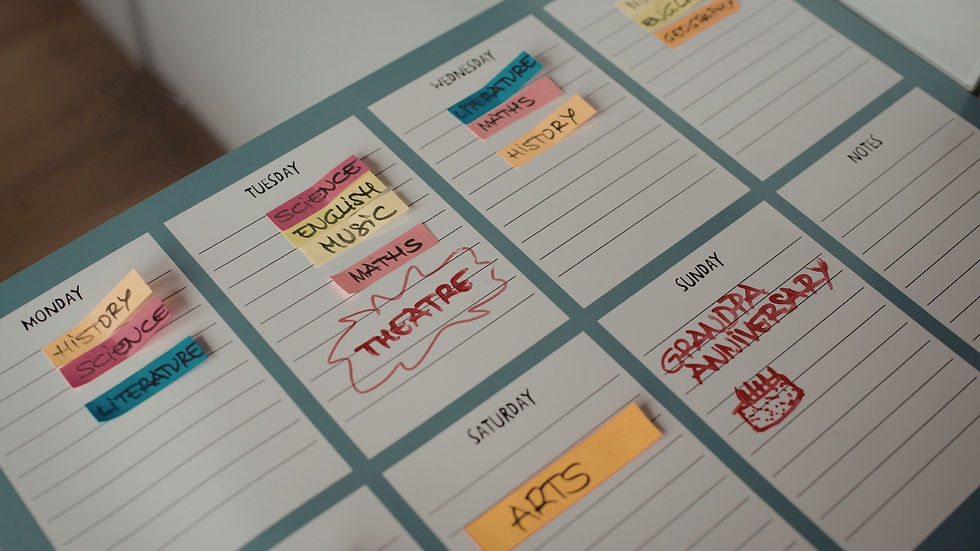
Physical planning boards: Index cards on a wall or a large printed calendar work well for educators who prefer a tactile planning process. Moving cards around makes it easier to see the year's flow.
Portfolio management tools: Platforms like Transparent Classroom let you track student progress, maintain portfolio documentation, and connect your curriculum map to real evidence of student learning.
Whatever you choose, what matters most is that you actually use it. A simple spreadsheet you update every six weeks does more for your students than a sophisticated system you abandon by November.
Also Read: Free Online Lesson Planner for Teachers
How TSH Anywhere Supports a Microschool?
Building a curriculum map from scratch is doable, but it takes real time, especially when you are also managing daily operations, parent communication, and lesson delivery.

The School House Anywhere (TSHA) is a program built specifically for microschool educators, homeschooling families, and education entrepreneurs running Pre-K to 6th-grade learning environments. It is powered by the American Emergent Curriculum (AEC), a hands-on, thematically organized framework designed for small, mixed-age classrooms.
Here is what TSHA provides that directly supports curriculum mapping.
Packaged 6-week learning sessions: The AEC is structured in six-week thematic cycles, so your year already has a clear shape before you start planning.
Custom AEC printable materials and worksheets: Ready-to-use, hands-on resources designed for each unit. No hunting across multiple platforms or building materials from scratch.
Online progress and portfolio management: TSHA gives you access to Transparent Classroom, a portfolio tool for documenting student progress and meeting state record-keeping requirements.
LIVE educator and founder gatherings: Weekly live sessions covering curriculum delivery, classroom management, and planning questions. You can ask the people who built the curriculum directly.
Online educator community: Connect with other microschool educators facing the same challenges and share strategies and real-world solutions.
Final Thoughts
A strong microschool curriculum map gives you direction without taking away flexibility. It helps you stay clear on what you are teaching, how skills build over time, and how to track real progress without falling into reactive, week-to-week planning.
Building and maintaining that level of clarity on your own can take more time than expected, especially alongside teaching and daily operations.
The School House Anywhere (TSHA) offers a curriculum organized into learning cycles that use themes and projects to connect subjects, along with ready-to-use materials and progress tracking tools designed for microschool environments. It gives you a structured foundation while still allowing you to adapt based on your students.
The goal is to have a system you can rely on, adjust as needed, and actually use throughout the year.
Explore TSHA to simplify your curriculum planning and build your microschool with more clarity.
Frequently Asked Questions
1. How long does it realistically take to build a microschool curriculum map?
Most educators can build a basic microschool curriculum map in one to two days, then refine it over time as they observe student needs and pacing.
2. Do I need to follow state standards when creating my curriculum map?
Requirements vary by location, but aligning loosely with state standards can help ensure coverage while still allowing flexibility in how learning is structured and delivered.
3. Can I reuse the same curriculum map every year?
You can reuse the structure, but most educators adjust themes, pacing, and activities each year based on student needs, making the map a reusable but evolving framework.
4. What is the best format for sharing a curriculum map with parents?
A simplified, visual version works best for parents, highlighting themes, skills, and outcomes rather than detailed internal planning elements such as daily activities or material lists.
5. How do I handle students moving at different paces within the same map?
Use the same theme but vary the depth and output expectations, allowing students to progress at different speeds while staying connected to shared topics and learning experiences.



Comments