6 Best Homeschool Programs in Nevada You Can Start in 2026

You pulled your child out of school, or you are about to. Either way, you are now the one responsible for making sure they actually learn, and the list of programs telling you they can help is longer than your school day.
Nevada gives you almost no guardrails, which sounds like freedom until you realize it also means no one will catch a bad decision for you. File a notice, write an education plan, and you are legally clear to use whatever you want. The pressure of that choice lands entirely on you.
This guide cuts through the noise on the best homeschool programs in Nevada. It covers the programs worth your serious attention, tells you exactly who each one works for, and is direct about where each one falls short. Read it once, and you will know where to start.
Key Takeaways
Nevada homeschooling is low-regulation, requiring only a one-time Notice of Intent and no mandatory testing, giving parents full control over curriculum and schedule.
Programs like The School House Anywhere, Power Homeschool, Oak Meadow, and Blossom & Root differ in structure, screen use, and parent involvement, making fit a key factor.
Homeschooling costs range from free options like Discovery K12 to paid programs, with typical annual spending reaching up to $1,800 per child.
Hands-on programs require more parent involvement, while video-based options support independent learning but increase screen time.
Support from co-ops, local groups, and statewide networks helps with socialization, resources, and long-term sustainability.
Why Nevada Is a Strong State for Homeschooling?
If you are wondering how Nevada's rules affect your options, the short answer is: the state mostly stays out of your way. That is not an accident. Nevada was one of the first states to legalize homeschooling, doing so in 1947, decades before most states followed suit.
What the Law Actually Requires
Nevada homeschooling is governed under NRS 388D. The requirements are minimal and parent-led. Here is what you need to know before you start:
File a one-time Notice of Intent with your local school district superintendent before you begin teaching.
Attach an educational plan covering the four required subject areas: English language arts, mathematics, science, and social studies.
No teaching credential is required. No minimum hours or days per week are mandated.
No standardized testing is required. State exams are available but entirely optional.
Your child can still participate in public school sports and extracurricular activities under NRS 388D.070.
One important note for 2026: Nevada's Education Savings Account (ESA) program remains dormant. Legislation to revive it with roughly $6,000 to $7,000 per student annually did not advance in the 2025 session. Families can access federal Coverdell Education Savings Accounts and Nevada's Opportunity Scholarship through some scholarship-granting organizations, but there is currently no active state-funded ESA.
What to Look for in a Homeschool Program
Before reviewing specific programs, it helps to know what questions to ask. A program that works beautifully for one family can be the wrong fit for another. Here are the factors that matter most when making your decision.
Factor | Why It Matters |
Grade range | Some programs cover early childhood only. Others span K-12. Match this to where your child is now, not just where they are today. |
Screen vs. hands-on learning | Heavy screen use works for some families and creates real problems for others. Know your child's tolerance and your own philosophy before committing. |
Structure level | Highly scripted programs plan every lesson for you. Framework-based programs give you flexibility to lead. Neither is better. It depends on your teaching style. |
Secular vs. faith-based | Many programs integrate religious content. If you need a secular, inclusive curriculum, verify this before purchasing. |
Cost and commitment | Annual programs lock you in for a full year upfront. Session-based programs let you test the fit before committing. Know exactly what you are paying for. |
Support access | Live support, educator access, and active communities reduce the learning curve. Find out what support actually looks like before you enroll. |
Keep this framework beside you as you read through the programs below. Use it to cross-reference each option against what your family actually needs, not what sounds good in a marketing description.
Best Homeschool Programs in Nevada for 2026
Every program listed here is a genuine homeschool program available to Nevada families. They cover a range of approaches, structures, and philosophies so you can find what fits your child and your teaching style.
1. The School House Anywhere (TSHA)

Best for: Pre-K to 6th-grade families who want structured, hands-on, secular learning with live educator support.
The School House Anywhere (TSHA) is a homeschool program built around the American Emergent Curriculum (AEC), a secular, developmentally-aligned framework for Pre-K through 6th grade. Subjects are taught through real-world projects, storytelling, and hands-on activities rather than screen time. Learning runs in 6-week modules, which lets children go deep on a topic before moving on and gives new families a lower-risk entry point before committing to a full year.
The program includes custom printable materials, a progress and portfolio management tool, LIVE educator gatherings, live office hours, and a member community. For micro-school educators and education entrepreneurs in Nevada, TSHA also offers operational support for building and running a structured learning environment.
Cost: Subscription-based, structured in 6-week session packages.
Grade range: Pre-K through 6th grade.
Learning approach: Hands-on, project-based, cross-subject integration.
Screen use: Low. Learning is primarily an activity and print-based for students.
Secular: Yes, inclusive for families of all backgrounds.
Support: 24/7 live support, LIVE educator gatherings, live office hours, member community.
Head to tshanywhere.org, register as a parent or educator, and start your first AEC session.
2. Power Homeschool (Acellus)

Best for: Families who want a self-paced, video-based program that lets students work more independently.
Power Homeschool delivers instruction through pre-recorded video lessons from actual teachers. Students work through core subjects at their own pace using automated assessments that track progress and flag knowledge gaps through what Acellus calls Vectored Instruction. Parents access a reporting portal to monitor completion and performance without needing to deliver daily lessons themselves.
This program suits families where the parent cannot be present for full daily instruction, or where an older student has the self-direction to work through video lessons independently. It is primarily digital, which is worth considering if your family is trying to reduce screen time for younger children.
Cost: Subscription-based, approximately $30 per month.
Learning approach: Pre-recorded video lessons with automated grading.
Parent role: Progress monitoring via online portal.
Screen use: High. Instruction is delivered entirely through video.
Limitations to Consider:
High screen time may be a concern, especially for younger learners.
Limited hands-on or experiential learning opportunities.
Students may struggle without strong self-discipline or parental oversight.
3. Oak Meadow
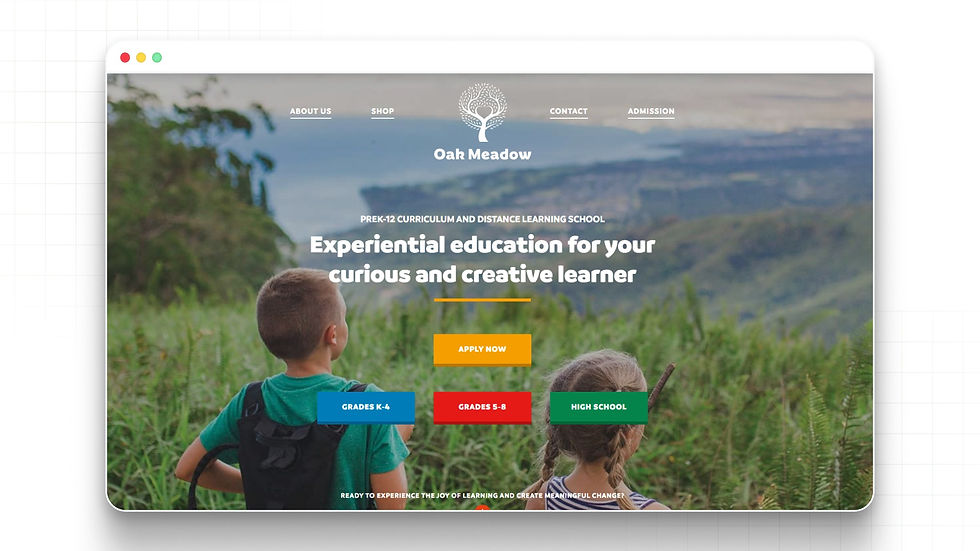
Best for: Families drawn to a Waldorf-inspired, nature-based, secular approach that emphasizes creativity and experiential learning.
Oak Meadow is an accredited, secular homeschool curriculum for Pre-K through 12th grade with a philosophy rooted in whole-child development. Lessons are built around observation, artistic expression, outdoor exploration, and projects rather than textbook instruction. The curriculum is designed to be flexible and parent-led, with clear lesson guides that give parents the structure to teach without rigid scripting.
Oak Meadow's secular stance makes it accessible to families from all backgrounds, and its emphasis on nature and creativity resonates with parents who want education to feel connected to the real world. Optional enrollment in a distance-learning school is available for families seeking accreditation and teacher feedback.
Cost: Curriculum packages vary by grade; distance learning enrollment is available separately.
Learning approach: Nature-based, arts-integrated, experiential learning.
Secular: Yes, fully secular and inclusive.
Screen use: Low to moderate, depending on how materials are used.
Limitations to Consider
Slower, less structured pacing may not suit families seeking academic rigor or clear benchmarks.
Requires active parent involvement in teaching and interpreting lessons.
It can feel abstract for children who prefer direct instruction.
4. Blossom & Root

Best for: Early-elementary families seeking a secular, nature-based program with STEAM integration and flexible scheduling.
Blossom & Root is a secular, nature-focused curriculum designed for PreK through 5th grade. It emphasizes STEAM integration through creative projects, outdoor observation, and hands-on activities. Curriculum packages are digital and range from roughly $40 to $90 per year, making it one of the more affordable structured options for early learners.
The program is gentle in pacing, which suits families with young children who learn better through play and exploration than structured academic instruction. Parents have the flexibility to pace lessons across the week in whatever format fits their schedule.
Cost: $40 to $90 per year (digital packages)
Learning approach: Nature-based, STEAM-integrated, hands-on projects
Secular: Yes
Screen use: Low. Curriculum is primarily printable and activity-based
Limitations to Consider:
A light academic structure may not meet expectations for more rigorous learning.
Best suited for younger children; may feel insufficient as students progress.
Requires parent planning and supplementation in some subjects.
5. Discovery K12

Best for: Budget-conscious families seeking a free, secular, structured program to serve as a foundation.
Discovery K12 provides a free, secular curriculum for PreK through 12th grade, covering 180 days of pre-planned lessons across core subjects through a straightforward daily checklist. It does not store student data, so parents handle grading and record-keeping themselves. For families on a tight budget who need a starting structure, it is a practical option.
The platform is primarily digital, with printable workbooks available separately for purchase if you prefer less screen time. Because it covers all grade levels with one consistent format, it is a reasonable choice for multi-age families who want everyone working from the same system.
Cost: Free (optional printed workbooks available for purchase).
Learning approach: Digital, reading, and video-based, self-paced.
Secular: Yes.
Parent role: Grading and record-keeping are fully managed by parents.
Limitations to Consider:
No built-in grading or record-keeping system, placing full responsibility on parents.
Primarily, a digital format may not suit low-screen families.
Lacks depth and customization compared to paid programs.
6. Moving Beyond the Page

Best for: Families with curious, literature-loving learners in grades K-8 who want an integrated, project-based approach.
Moving Beyond the Page is a secular, literature-integrated curriculum for kindergarten through 8th grade. It weaves language arts, science, social studies, and math together through a unit-study design centered on living books and hands-on cross-disciplinary projects. The curriculum is designed so that subjects connect naturally rather than being taught in isolation.
Each unit is built around a central book or theme, with activities that extend the learning across subjects. Parents receive detailed lesson guides, but the curriculum rewards active parental involvement rather than independent student use. It works particularly well for children who are strong readers or who learn best through narrative and project-based exploration.
Cost: Unit packages priced individually; multi-subject bundle options available.
Learning approach: Literature-based, unit study, hands-on projects.
Secular: Yes.
Screen use: Low. Primarily book and activity-based.
Limitations to Consider:
Requires significant parent involvement and preparation.
It can be time-intensive due to a project-based structure.
Less suitable for children who prefer independent or digital learning.
Resources Available to Nevada Homeschool Families
Nevada has a solid network of support for homeschooling families. Knowing what is available before you start means you are not building everything from scratch, and your child can connect with other learners from early on.
Statewide Organizations
Nevada Homeschool Network (NHN) at nevadahomeschoolnetwork.com is the primary statewide advocacy and resource organization. It publishes legal guidance, sample NOI forms, county-specific support group listings, and legislative updates that directly affect Nevada homeschoolers.
Northern Nevada Home Schools (NNHS) at nnhs.org serves the Reno and northern Nevada region with a directory of local groups, tutors, co-op classes, and homeschool-friendly businesses.
The Nevada Homeschool Convention (NEVCON) returned in 2026. It runs annually and covers curriculum, legal topics, and community building for families at every stage.
Co-ops and Learning Groups
Co-ops let families share teaching, split costs, and give children regular time with other learners. Here are active options across Nevada:
Las Vegas area: Colorful Geniuses Homeschool Co-op (secular, colorfulgeniuses.com), IMPACT Homeschool Co-op, and Las Vegas Life Learners (secular, unschooling-friendly) are among the active Clark County groups.
Reno and Northern Nevada: Eagle Co-op (founded 1995, serves greater Reno and Sparks), WILD enrichment program in Sparks, and Freedom Co-op with drop-off locations in Reno, Carson City, and Gardnerville.
For faith-based families, EAGLES Homeschool Group LV (Clark County), FAITH Homeschoolers (Carson City and Douglas County), and Eagle Christian Co-op in Sparks all offer weekly classes and events.
NHN's county support pages list current contacts for groups across Clark, Washoe, Carson City, Douglas, and other counties.
Filing and Legal Help
Washoe County School District now has an online portal for submitting your Notice of Intent, removing the need to mail or hand-deliver paperwork.
Clark County families should know that CCSD has attempted to require extra forms beyond what Nevada law mandates. NHN publishes alerts on what you are and are not legally required to sign.
HSLDA maintains a plain-language summary of Nevada homeschool law and provides legal support to members if a school district complicates your Notice of Intent filing.
Enrichment and Field Trip Opportunities
Nevada has solid educational venues and programs that pair well with any homeschool curriculum:
The Nevada Museum of Art in Reno, the Discovery Children's Museum in Las Vegas, and the Fleischmann Planetarium at UNR all offer homeschool-specific programs and group rates.
Clark County Library District offers STEAM programming specifically for homeschoolers, and most branches offer reading and enrichment programs for homeschool families.
Great Basin College in Elko offers dual-enrollment courses for Nevada students, worth tracking as children approach upper-elementary and middle-school age.
The Every Kid Outdoors pass gives 4th graders and their families free access to National Parks. Nevada's Great Basin National Park and nearby Death Valley are both practical options for science and geography field work.
Steps for Getting Started with Homeschooling in Nevada

If you have not yet filed your Notice of Intent, here is what the process entails. It is simpler than most new homeschool parents expect, and you can move through all four steps before your first teaching day.
Step 1: File Your Notice of Intent
This is the only legal paperwork Nevada requires. Download the standard Notice of Intent to Homeschool form from the Nevada Department of Education website, complete it with your child's details, and attach an educational plan covering the four required subjects. Submit to your local school district superintendent before you begin teaching.
If withdrawing from public school, file within 10 days of formal withdrawal.
If you just moved to Nevada, file within 30 days of establishing residency.
The district is required to send you a written acknowledgment. Keep it as your proof of legal compliance.
You only file once per child unless your address or the child's enrollment status changes.
Step 2: Choose Your Program and Set a Budget
Use the comparison table above to narrow down to one or two programs that fit your child's age, your teaching approach, and your family's values. If you are unsure which direction to go, start with a shorter commitment before locking in a full year.
TSHA's 6-week sessions let you run a full module before deciding on the next step.
Blossom & Root's annual packages are under $90 and low-risk for early elementary families.
Nevada's ESA program is dormant in 2026, so budget for out-of-pocket costs. Most mid-range families spend $900 to $1,800 per child annually across curriculum, materials, and activities.
Check whether you qualify for the Nevada Opportunity Scholarship or a federal Coverdell ESA to offset costs.
Step 3: Set Up a Consistent Learning Space
Nevada does not require a dedicated classroom, but a consistent space makes a real difference in how children settle into learning each day. You do not need a separate room. You need a spot that signals to your child that school time has started.
Choose one spot used only for schoolwork, even if it is a corner of the kitchen table.
Keep materials organized and within reach so you are not hunting for supplies mid-lesson.
Set a predictable daily start time so the routine becomes the structure, not the space.
For hands-on programs like TSHA and Blossom & Root, a small supply station with art materials and printables nearby keeps lessons moving without interruption.
Step 4: Connect with Nevada's Homeschool Community
Nevada has a well-established homeschool network, and connecting early makes a genuine difference. The Nevada Homeschool Network (NHN) is the best first stop for legal resources, sample NOI forms, and county-specific support group listings.
Visit nevadahomeschoolnetwork.com for legal guidance and county contact lists.
Search local Facebook groups for homeschool co-ops in your area. Both Clark County and Washoe County have active ones.
Wrapping Up
The best homeschool programs in Nevada are the ones you can run consistently without questioning your choice every week. A good fit will match your child’s pace, your level of involvement, and the kind of learning you want at home.
The options in this guide vary for a reason. Some are more independent, some need active teaching, and some give you a balance of both. What matters is choosing one that fits how your home actually works.
If you want to see how a hands-on, structured approach looks in practice, you can explore curriculum samples from The School House Anywhere before making a decision.
FAQs
1. How do I switch between homeschool programs in Nevada mid-year?
You can switch homeschool programs at any time in Nevada, since there is no approval process, but you must continue to cover the required subjects in your educational plan.
2. Are online homeschool programs in Nevada considered full homeschooling?
Yes, online programs count as homeschooling if parents remain responsible for instruction and compliance, even when lessons are delivered digitally through structured or self-paced platforms.
3. Can homeschool students in Nevada graduate with a recognized diploma?
Homeschooled students can graduate with parent-issued diplomas, though some families choose accredited programs or distance learning schools for more widely recognized academic documentation.
4. Do homeschool programs in Nevada provide transcripts and records?
Some homeschool programs offer built-in transcripts and progress tracking, but in many cases, parents are responsible for maintaining academic records and documenting student progress.
5. How do I know if a homeschool program is too advanced or too easy?
If your child consistently struggles or finishes work too quickly without challenge, it may indicate a mismatch, and adjusting the pace or switching programs becomes necessary.



Comments